Skyraider «Wiley Coyote»
Follow me on Instagram to get the most recent updates (@saschaschindelholz).
With aircraft like the F-4, B-52, and SR-71 patrolling the skies, the United States Air Force was well into the jet age by the time of the Vietnam War. However, propeller-driven A-1 Skyraiders were still called on to perform some of the war’s most dangerous jobs. Its weapons load and 10-hour flying time far surpassed the jets that were available at the time. On 2 May 1951, Skyraiders made the only aerial torpedo attack of the war, hitting the Hwacheon Dam, then controlled by North Korea.
The A-1 Skyraider received various nicknames including: «Spad», «Super Spad» (derived from the aircraft's AD designation, its relative longevity in service and an allusion to the «Spad» aircraft of World War I) and «Able Dog» (phonetic AD)
Wiley Coyote, an A-1H (AD-6) Skyraider served in the Air Force’s 6th Special Operation Squadron. During 1968 and 1969, the aircraft was based out of Pleiku and Da Nang, South Vietnam. Using the call sign SPAD, the primary mission of the Skyraiders of the 6th SOS was to support the Studies and Observations Group – an elite joint special operations unit.
During its time with the 6th SOS, Wiley Coyote was piloted by Lt. Col. Dan Wiley, a seasoned airman who got his start in the cockpit of P-51s and P-38s during WWII. Following the war, Wiley served as a performance instructor and test pilot at Edwards Air Force Base and Wright Paterson Air Force Base. During this time, he helped develop some of the most advanced aircraft of the day, including the F-94 Starfire, F-104 Starfighter, F-105 Thunderchief and F-106 Delta Dart. He also holds the distinction of being the first USAF pilot to test fly-by-wire controls, according to his family.
Text-Source: Wikipedia / airforceheritageflight.org
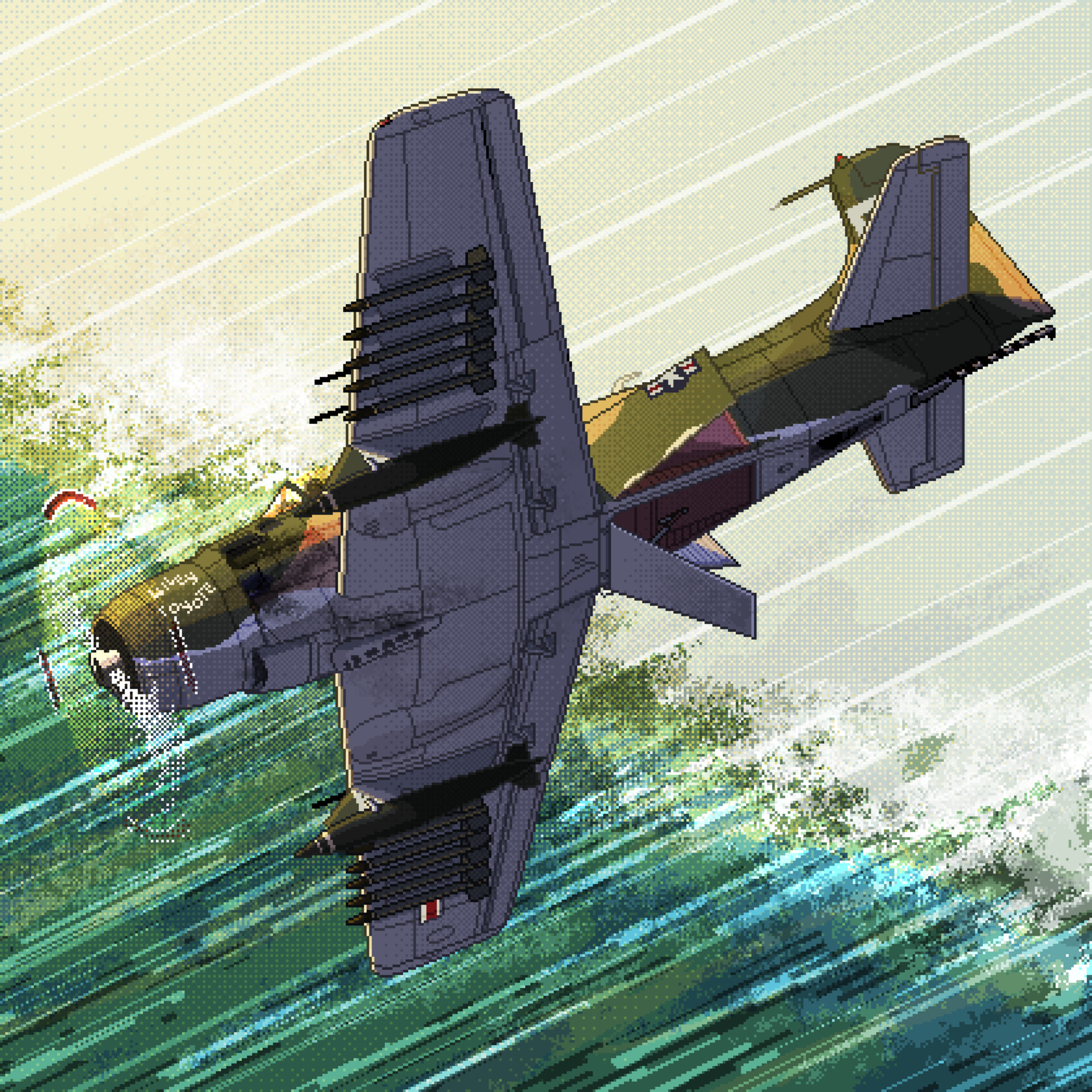
Skyraider «Wiley Coyote»