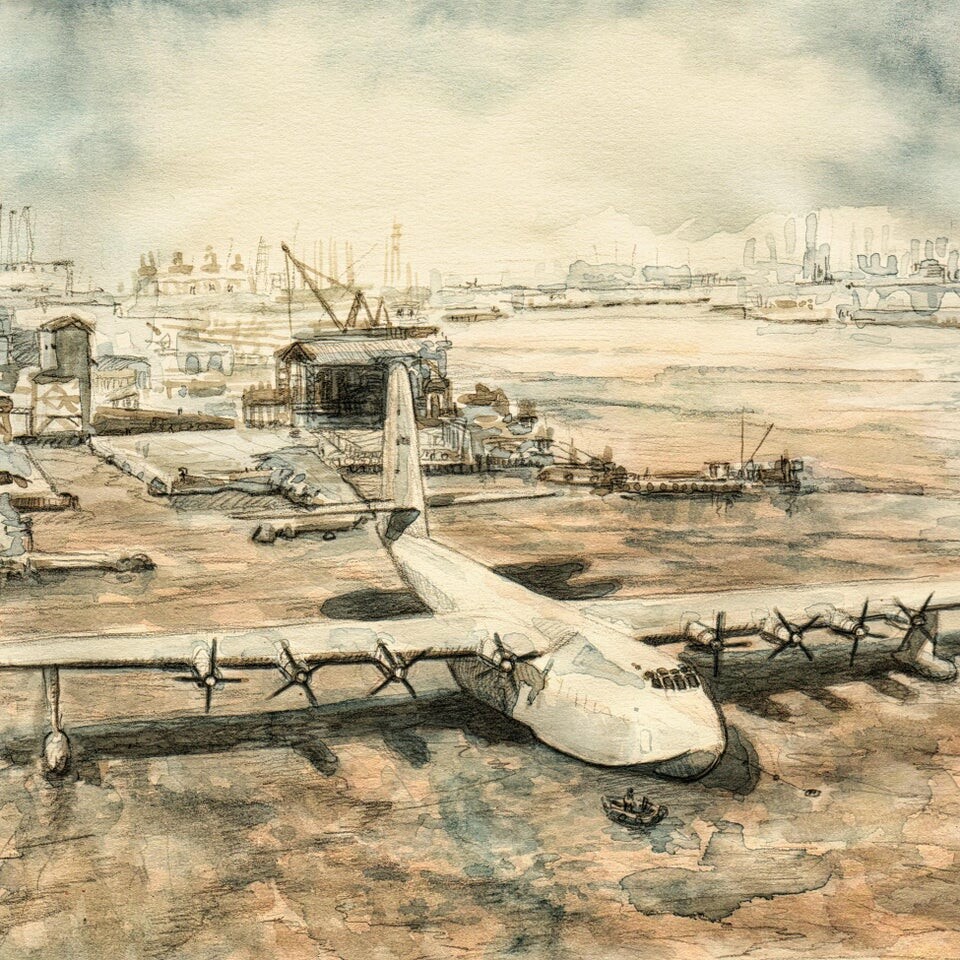
𝐒𝐩𝐫𝐮𝐜𝐞 𝐆𝐨𝐨𝐬𝐞' 𝐌𝐚𝐢𝐝𝐞𝐧 𝐅𝐥𝐢𝐠𝐡𝐭
Follow me on Instagram to get the most recent updates (@saschaschindelholz).
The largest wooden airplane ever constructed, and flown only one time, the Spruce Goose represents one of humanity's greatest attempts to conquer the skies. It was born out of a need to move troops and material across the Atlantic Ocean, where in 1942, German submarines were sinking hundreds of Allied ships. Henry Kaiser, steel magnate and shipbuilder, conceived the idea of a massive flying transport and turned to Howard Hughes to design and build it. Hughes took on the task, made even more challenging by the government’s restrictions on materials critical to the war effort, such as steel and aluminum. Six times larger than any aircraft of its time, the Spruce Goose, also known as the Hughes Flying Boat, is made entirely of wood.
☁️
The winged giant made only one flight on November 2, 1947. The unannounced decision to fly was made by Hughes during a taxi test. With Hughes at the controls, David Grant as co-pilot, and several engineers, crewmen and journalists on board, the Spruce Goose flew just over one mile at an altitude of 70 feet for one minute. The short hop proved to skeptics that the gigantic machine could fly.
☁️
Perhaps always dreaming of a second flight, Hughes retained a full crew to maintain the mammoth plane in a climate-controlled hangar up until his death in 1976.
☁️
The Spruce Goose was kept out of the public eye for 33 years. After Hughes’ death in 1976, it was gifted by Hughes’ Summa Corporation to the Aero Club of Southern California. In 2001, the Sproose Goose found its final destination in the Evergreen Aviation & Space Museum in Oregon.
☁️
Text-Source: evergreenmuseum.org